School Boy Hold Placard: A Practical Embroidery Design Review
When a fellow maker asked me to help prepare a custom tote bag for a retiring kindergarten teacher, I immediately thought of designs that feel personal, warm, and just a little nostalgic. That search led me to School Boy Hold Placard. Empty Paper Ban. As an embroidery designer and product reviewer, I don’t just look at what a graphic shows on screen—I think about how it will translate into thread, how it will hold up on fabric, and whether it will actually sell as a finished product. This illustration, part of the Illustrations category and offered as a Graphics type, turned out to be a surprisingly versatile starting point for custom embroidery work.
First Impression: Playful Nostalgia with a Blank Canvas
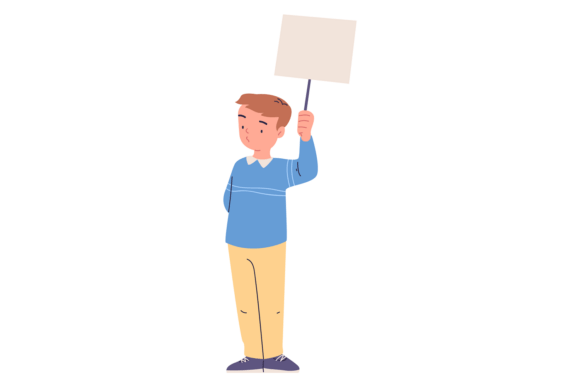
The design shows a cheerful school boy holding a large placard. The paper banner is completely empty, which is exactly what makes School Boy Hold Placard. Empty Paper Ban so useful. There’s a sense of anticipation in the composition—this isn’t a finished message, it’s a frame waiting for someone’s name, a date, or a short phrase. The mood is friendly, approachable, and gently academic without being stiff. For embroidery, that kind of emotional clarity matters. A design that already tells a story makes the final product feel more intentional.
The clean, isolated background and the simple linework of the illustration suggest it will digitize cleanly. The file formats provided—EPS, JPG, SVG, and transparent PNG—give us exactly what we need to either use the graphic as a mockup for a client or import it directly into embroidery software. The transparent PNG is especially handy for layering over fabric photos when creating Etsy listing previews. As a graphic asset, it’s built for flexible use, which is exactly what craft business owners need.
Real-Life Scenario: A Teacher’s Retirement Tote
Let me walk you through the actual project that put this design to the test. The client wanted a natural canvas tote bag for a retiring teacher, with the school boy holding a sign that read “Thanks for the Adventures, Mrs. Lee.” The empty banner was the perfect placeholder. I digitized the boy and the placard as one unit, then created a separate text object for the message. That approach allowed me to test the thread tension and stitch density on the boy figure before adding the lettering, which can be tricky on textured cotton fabric.
On a 12-inch by 14-inch tote bag panel, the design had to be large enough to make the text legible but not so large that the boy’s details became overwhelming. I scaled the graphic to about 5 inches wide, which gave the banner roughly 3 inches of text space. After two test stitch-outs, the final result looked crisp, friendly, and completely professional. The teacher cried when she opened it—proof that the right design, used thoughtfully, can carry real emotional weight.
How the Design Performs in Embroidery Settings
When evaluating any graphic for embroidery, I look at three things: detail level, color separation, and how it handles the conversion from vector art to stitch file. School Boy Hold Placard. Empty Paper Ban scores well on all three for a few reasons. The boy’s features are simple: a rounded cap, a neat uniform, a straightforward pose. There are no overly complex gradients or photographic textures, which means the digitizer can rely on clean satin stitches and well-placed running stitches. The empty banner is a large, regular shape that can be filled with a satin-stitch border and a light fill stitch, or even turned into an appliqué element if you want to save time and add texture.
Because the banner is empty, you can place it on the fabric and then add felt or twill fabric as an appliqué piece before stitching the boy on top. That technique works beautifully on sweatshirts, aprons, and pillow covers. For the retirement tote, I used a light beige twill appliqué for the paper banner, then stitched the lettering over it. The result felt dimensional and deliberate, like a tiny sign sewn onto the bag.
Where This Design Shines
- Custom apparel: Sweatshirts, t-shirts, and hoodies become personalized gifts when you add a name or a short message on the banner.
- Tote bags and backpacks: Perfect for back-to-school boutiques, teacher appreciation items, or library fundraisers.
- Baby and nursery decor: Stitch the design on a baby blanket or a birth announcement hoop with the child’s name and birth date. The school theme may seem unexpected, but the “first day of school” milestone is a huge seller for future keepsakes.
- Holiday gifts: Imagine a version on a kitchen towel for a teacher’s Christmas present, or a stitched ornament with the year on the banner.
- Patches and caps: The simple, centered composition works well on a structured cap front or as a standalone patch, provided you simplify the smallest details.
Practical Considerations and Cautions
No design is flawless, and School Boy Hold Placard. Empty Paper Ban does require a bit of care. The boy’s hands holding the placard and the edges of the paper banner can become dense pinch points if the digitizing isn’t adjusted. I always recommend testing on scrap fabric first, especially to check that the tiny fingers don’t form a dense, bulletproof stitch block that distorts the fabric. Use a medium-weight cutaway stabilizer on knit fabrics to prevent puckering.
Small hoop sizes are a real constraint here. If you try to fit the design into a 4x4 inch hoop, the text on the banner will likely become unreadable unless you use a very short word. For most projects, I recommend a hoop size of at least 5x7 inches. On textured fabrics like terry cloth or heavily napped fleece, the banner’s empty space can lose definition if the fill stitch is too light. A denser satin border around the banner helps lock it in place visually.
Dark fabric is another challenge. The school boy’s darker uniform details can disappear against a navy or black sweatshirt. I always test the design in black-and-white mockups first to see if the values hold up. If not, I add a subtle outline or a contrasting background shape behind the boy. The transparent PNG from the original file set is a lifesaver for this kind of pre-digitizing test.
Fabric and Product Pairings
From my tests, this design works best on stable, medium-weight fabrics. Cotton canvas, linen blends, and twill tote bags are ideal. On stretchy fabrics like jersey or ribbed knit, the boy’s straight lines can warp slightly if you don’t use a fusible backing. I’ve also had success on denim jackets and quilted jacket backs, where the structured fabric holds the stitches beautifully. Avoid ultra-thin fabrics like lightweight chiffon—the design’s density will overwhelm them.
For products that need frequent washing, like baby onesies or kitchen towels, I recommend taking extra care with the thread choice. Polyester embroidery thread holds up better than rayon, and I always include a quick wash test in my process before listing a finished good for sale. The boy’s face, while simple, includes a few small eye and mouth details that can become fuzzy after multiple washes if the stitch length is too short. I lengthen the running stitches slightly in those areas.
The Designer’s Workflow: From Graphic to Finished Product
I treated School Boy Hold Placard. Empty Paper Ban as a hybrid design asset. First, I opened the SVG file in my embroidery software to trace the clean vector paths. This gave me a solid base with minimal node cleanup. Then I assigned thread colors: a soft navy for the uniform, oatmeal for the banner, and skin-tone threads for the face and hands. The boy’s cap and shoes got a pop of deep red for contrast. I kept the total color count to five, which is manageable for a single-needle machine and keeps production time reasonable.
After digitizing, I ran three test stitches. The first on scrap cotton showed the banner fill was too sparse, so I increased the stitch density slightly. The second on a thin sweatshirt material revealed slight pulling at the corners of the placard, so I angled the underlay stitches to 45 degrees. The third test, on the final canvas tote, was clean and ready to sell. That iterative process is non-negotiable if you want to build trust with buyers and keep your shop’s reputation solid.
Commercial Use and Licensing Awareness
Since this is a graphics product, not a pre-digitized embroidery file, you need to confirm the license terms before selling finished products. The description mentions EPS, JPG, SVG, and transparent PNG files, but it doesn’t explicitly state commercial use rights for physical merchandise. I always reach out to the designer or check the platform’s license agreement before I invest hours in digitizing. If you plan to sell the digitized embroidery file itself, that’s a separate layer of licensing that usually requires an extended commercial license. For the teacher tote bag, I confirmed the graphic could be used on physical items for resale, and I kept a copy of the permission in my project folder.
Final Verdict from a Maker’s Perspective
School Boy Hold Placard. Empty Paper Ban is a thoughtful, well-structured graphic that gives embroidery designers a lot of creative room. The empty banner is the real star—it transforms a simple school-themed illustration into a customizable template that fits dozens of product niches. Whether you’re building a small shop collection around back-to-school items, testing a new personalized gift line, or just want a reliable design for client projects, this one is worth a close look. With the right digitizing choices, proper stabilizer, and a few test runs, the final embroidered product can carry the kind of handmade warmth that customers genuinely love.