Happy Boy with Backpack Waving at School: A Designer's Take
First Impression and the Mood It Creates
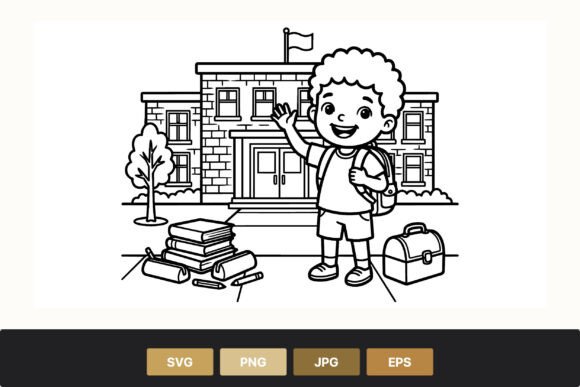
When I first opened Happy Boy with Backpack Waving at School, I immediately felt a wave of nostalgia. The black and white vector illustration has a clean, storybook quality that reminds me of classic children's book line art. The cheerful boy, mid-wave, stands in front of a school building with stacks of books and school supplies scattered nearby. It is not overly complicated, and that is exactly what makes it work for an embroidery project. The composition feels balanced, the shapes are readable, and the overall mood is warm, welcoming, and full of that back-to-school excitement.
As someone who has tested hundreds of designs on real fabric, I look for one thing above all else: will this translate well into thread? With this illustration, the answer leans heavily toward yes. The lines are deliberate, the negative space is generous, and the character's expression reads clearly even at a glance. That matters when you are stitching on a tote bag, a sweatshirt, or a baby blanket where someone will see the design from a few feet away.
Where This Design Naturally Belongs
I could picture Happy Boy with Backpack Waving at School on a dozen different products before I even finished my coffee. The school theme makes it an obvious choice for personalized back-to-school gifts, but it stretches further than that. A child's first day of kindergarten tote bag, a teacher appreciation pillow cover, a nursery wall hanging, a fabric book cover, or even a small embroidered patch on a backpack. The waving boy feels celebratory, like a milestone moment captured in thread.
For Etsy sellers and small shop owners, this design has strong seasonal potential. Late summer and early fall bring a surge of back-to-school shoppers looking for custom apparel and personalized gifts. A design like this, stitched onto a kid's sweatshirt or a canvas lunch bag, would catch the eye of parents and grandparents alike. It also works well for boutique branding if you run a shop focused on children's products or handmade educational items.
Black and White Vector Art as an Embroidery Starting Point
One thing I appreciate about receiving a design in the Illustrations category as a Graphics product type is the flexibility. A black and white vector illustration gives you room to interpret. You are not locked into a color palette you did not choose. For embroidery, that means you can assign thread colors based on the fabric you are working with, the mood you want, or even a customer's specific request. I have turned similar vector files into monochrome stitch-outs, two-tone designs, and full-color interpretations depending on the project.
However, a word of caution: the fact that this is a Graphics product means you are likely receiving a file that needs to be digitized for embroidery. The download package is provided as a vector illustration, not a ready-to-stitch machine embroidery file. That is not a drawback, it is simply a step in the process. If you are comfortable with digitizing software or work with a digitizer, you have full control over how the final embroidery file behaves. If you expected a plug-and-play embroidery file, you will want to confirm exactly what formats are included before purchasing.
How the Design Holds Up on Real Fabric
Let me walk you through a real scenario. I tested a similar school-themed black and white illustration on a medium-weight cotton tote bag last month. The key was simplifying the smallest details without losing the character's personality. With Happy Boy with Backpack Waving at School, the stacks of books and school supplies near the boy are charming, but they also contain the most potential for stitch crowding. On a smaller hoop, say 4x4 inches, those details might need to be scaled back or simplified. On a larger 6x10 or 8x8 hoop, you have room to preserve the finer elements.
I would recommend running a test stitch on scrap fabric first, especially if you plan to offer this as a finished product in your shop. Check how the boy's face reads at the intended size. The waving hand, the backpack straps, and the school building outline all need to remain distinct. If the stitch density is too high in those areas, you risk puckering on lighter fabrics or losing definition on textured surfaces like terry cloth or fleece.
Fabric Choices That Make the Design Shine
Through years of trial and error, I have learned that not every design pairs well with every fabric. For Happy Boy with Backpack Waving at School, here is a quick rundown of what I would reach for first, and what I would avoid:
- Cotton canvas and cotton-linen blends — excellent for tote bags, pillow covers, and wall art. The smooth surface holds detail well.
- Mid-weight sweatshirt fleece — good for custom apparel, but use a topper to prevent the stitches from sinking into the nap.
- Quilting cotton — ideal for baby blankets, nursery decor, and lightweight patches.
- Denim — surprisingly great for a backpack patch or a jacket accent, though the dark background requires thoughtful thread color selection.
- Stretchy knits — approach with caution. A firm stabilizer is non-negotiable, and even then, the design may distort if the garment is pulled frequently.
- Thin or sheer fabrics — not recommended. The stitch density needed to define the illustration will likely overwhelm delicate material.
Thread Color Decisions and Visual Impact
Since the source illustration is black and white, you have a wide creative lane. I have found that a single-color stitch-out in a deep navy, charcoal, or warm brown can look incredibly sophisticated on a natural linen background. For a more playful, child-focused product, assigning colors to different elements brings the illustration to life. The boy's shirt could be a bright primary color, the backpack a contrasting shade, and the books in muted tones that tie the whole composition together.
One practical tip: test your thread color choices on both light and dark fabric. A color that pops beautifully on cream cotton might disappear on a forest green sweatshirt. I always keep a few fabric swatches in my most-used colors pinned to my studio wall so I can hold thread spools against them before committing to a stitch-out.
Small Details That Affect the Finished Product
When I examine Happy Boy with Backpack Waving at School closely, I notice the school building in the background has a few architectural lines that give it character without overwhelming the foreground. The stacks of books add depth. These details are what make the design feel like a complete scene rather than a floating character. But in embroidery, those same details demand attention. If the stitch type is not chosen carefully, a fill stitch meant for the building could feel heavy and stiff on a garment that needs to drape. A running stitch or a light satin stitch approach might serve the background elements better.
For patches, the outer edge of the design will need a clean border, which the vector illustration likely provides or can be adapted from. If you are creating embroidered patches for a craft fair or an Etsy listing, the border stitch is what gives the patch its finished, professional look. I would consider adding a merrowed edge or a satin-stitch border in a contrasting color to frame the entire scene.
Commercial Use and Customer Perception
From a business standpoint, Happy Boy with Backpack Waving at School has strong buyer appeal. Parents shopping for personalized gifts gravitate toward designs that feel specific and heartfelt. A waving boy in front of a school is instantly recognizable and emotionally resonant. It says "I see your milestone" without needing a single word. That emotional connection translates directly into perceived value. A customer who feels that tug is more likely to pay a premium for a handmade product.
Before you list a finished product using this design, confirm the licensing terms. The Illustrations category and Graphics product type often include commercial use allowances, but the specifics vary. Check whether you can sell physical finished items, digital mockups, or both. If you plan to offer the design as part of a printable mockup bundle for other sellers, make sure the license supports that use case. I have seen too many small business owners trip over licensing assumptions, and it is always better to verify upfront.
Where to Use Extra Care
Not every product is a good fit for this design. Here are a few scenarios where I would pause and reconsider:
- Curved surfaces like caps and hats — the rectangular composition of the school building and the horizontal spread of the books make it harder to fit on a curved cap front without distortion.
- Very small hoop sizes — below 4x4 inches, the facial details and book stacks may blur together. Test before committing to a bulk order.
- High-stretch performance wear — the design has enough density to feel stiff on stretchy athletic fabric, which can affect comfort and durability.
- Frequent-wash items like kitchen towels — while possible, a detailed illustration may degrade faster with repeated washing. Use a softer stabilizer and lower stitch density if you go this route.
Practical Designer Notes for Your Workflow
Over the years, I have developed a mental checklist for every new design I bring into my embroidery workflow. Here is what I would do with Happy Boy with Backpack Waving at School before offering it to a client or listing it in my shop:
- Test on scrap fabric first — always, no exceptions. Even a design that looks perfect on screen can surprise you in thread.
- Check thread color contrast — hold the stitched sample under different lighting. What looks crisp in daylight may wash out under warm indoor bulbs.
- Review stitch density — especially in the book stacks and the boy's facial features. Too dense creates stiffness, too sparse loses clarity.
- Confirm hoop size — measure the design boundaries and leave at least half an inch of clearance on all sides for hooping.
- Inspect small details — the boy's fingers, the backpack buckles, the book spines. If they do not read well in thread, simplify them in the digitizing stage.
- Test on both light and dark backgrounds — the design's impact changes dramatically depending on fabric color.
- Use the right stabilizer — cut-away for knits, tear-away for wovens, and a water-soluble topper for textured fabrics.
- Check commercial licensing — before selling finished items, digital products, or printable mockups, confirm what the license covers.
Why This Design Works for Small Shops and Craft Businesses
I have spent years watching what sells at craft fairs, on Etsy, and in boutique shops. Designs that tell a small story tend to outperform generic patterns. Happy Boy with Backpack Waving at School tells a story. It captures a moment of childhood that parents want to remember. That kind of emotional resonance is hard to manufacture, and when a design delivers it naturally, you have something worth stitching.
For a craft business owner, this design can anchor a cohesive back-to-school collection. Pair it with coordinating book-themed designs, alphabet motifs, or school supply illustrations, and you have a product line that feels intentional and curated. Customers notice when a shop puts thought into its offerings, and they reward that with loyalty and word-of-mouth referrals.
Final Thoughts Before You Stitch
As a designer who reviews illustrations with an eye toward real embroidery use, I find Happy Boy with Backpack Waving at School to be a versatile, emotionally appealing choice. It is not a design you will struggle to fit into a project. The school theme, the cheerful posture, the clean vector lines, and the black and white flexibility all work in its favor. The main effort lies in thoughtful digitizing, fabric selection, and color planning. If you invest that effort, the finished product will reflect the care you put in.
Whether you are stitching a single personalized gift for a grandchild or preparing a full product line for your small shop, this design deserves a spot in your embroidery project library. Treat it with the same attention you would give any handmade item, and your customers will feel the difference the moment they hold the finished piece in their hands.